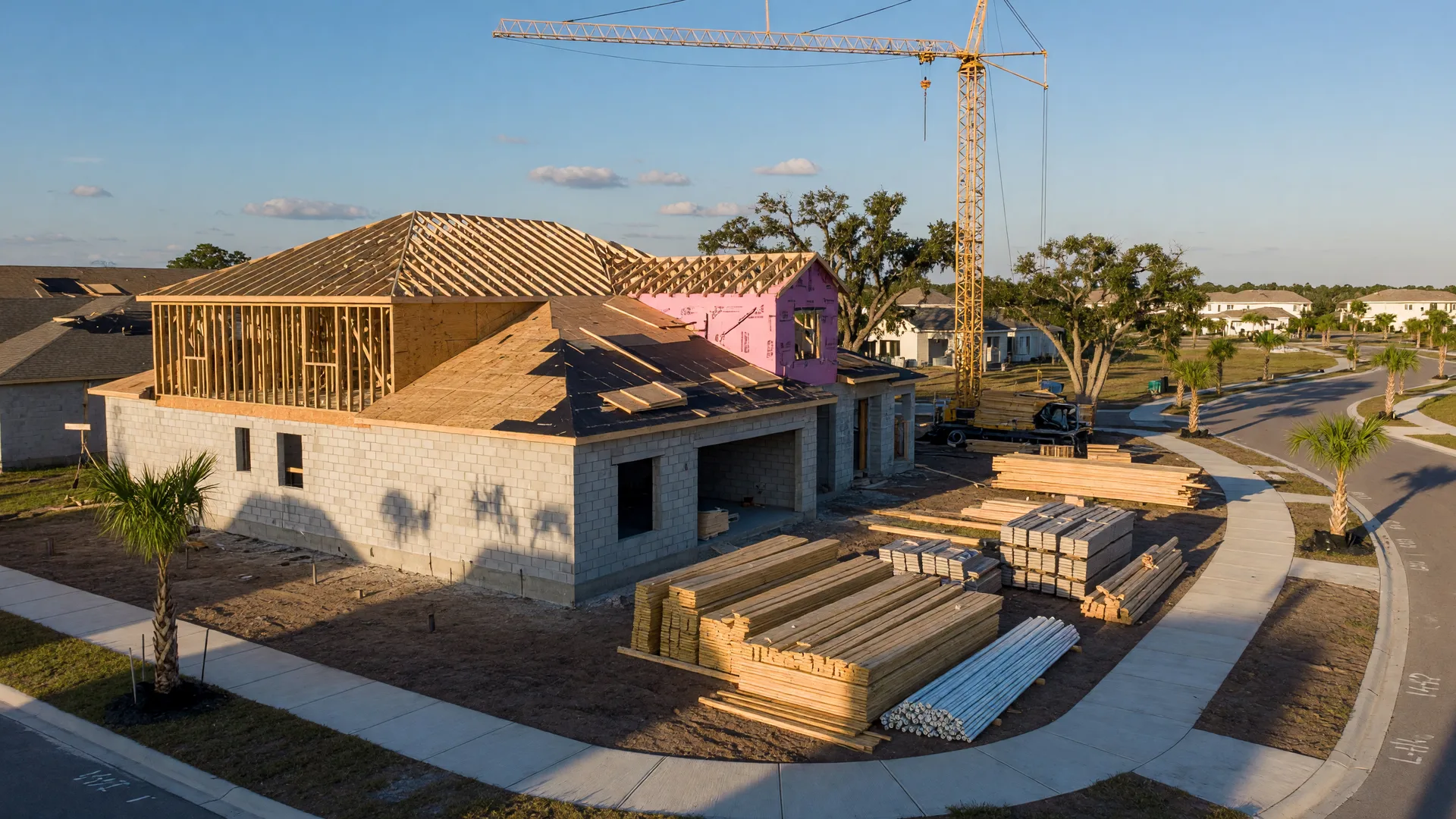
In Central Florida, a to-be-built production home typically takes about 6 to 10 months from signed contract to closing, and the actual construction on site is usually only 5 to 7 months of that window. Semi-custom homes commonly run 8 to 14 months, and fully custom builds 12 to 18 months or longer. The rest of the time is spent before construction starts and after it finishes: permits, financing, builder scheduling, finish selections, inspections, and closing. This post breaks down where the months actually go, what pushes a schedule out, and how to plan a move date that survives reality.
The short answer: 6 to 10 months for most production homes
Published figures from Florida builders and new-home guides put a typical production home, the kind built in volume in master-planned communities like Sunbridge, Horizon West, and EverBe, at roughly 6 to 10 months from contract to closing. Some Florida builders report 6 to 9 months, and builders elsewhere in the state describe 4 to 7 months from permit to move-in. None of these figures is a promise for a specific home; they are planning ranges, and the range matters more than any single number. Builders quote a schedule per community and per phase, so the sales team's estimate at contract is the number to write down and keep.
Why the total takes longer than the build itself
The months before the slab and after the final inspection are easy to forget, because the model home makes the process look instant. Before construction starts, the builder needs your executed contract and deposit, your financing needs to clear underwriting, the community's approvals and the county permit need to run, and the builder needs a construction slot in its current backlog. After the home is finished, the final inspection, the walkthrough, any punch list work, and the closing itself add days or weeks. In Central Florida, permits run at the county level: Osceola County for Sunbridge, Orange County for Horizon West and EverBe, and review pace differs by county and by how busy the permitting office is at the time.
Where the construction months go
Once construction starts, a production home follows a standard sequence: site work and foundation, framing and roof, rough-ins for plumbing, electrical, and HVAC, drywall, cabinets and trim, and finally flooring, paint, and finishes. The phase-by-phase detail is worth reading in our build timeline guide, but the planning takeaway is that the schedule is not spread evenly. Permit runs and finish work are the two stretches where schedules slip most, because both depend on third parties: county reviewers on one end, and the trades and suppliers delivering cabinets, windows, appliances, and fixtures on the other.
Semi-custom and custom builds run longer
The ranges above are for production homes. Semi-custom homes, where you work with the builder on floor plan adjustments and a longer selections list, commonly run 8 to 14 months. Fully custom homes, designed around your lot and your plans, typically run 12 to 18 months, and large or coastal custom builds can stretch to 20 to 24 months. The extra time is not mostly construction; it is design, engineering, and permitting before the first shovel, plus a longer finish phase with more custom materials. In the Central Florida communities this site covers, the overwhelming majority of new construction is production building, so most buyers should plan around the 6 to 10 month range and treat anything faster as a bonus.
The fastest path: quick move-in homes
Every large builder in Central Florida carries some finished or near-finished inventory: quick move-in homes, spec homes, and homes in later construction phases that can close in weeks rather than months. These are the fastest path to a new home, and they are also the least customizable, because the finishes, floor plan, and lot are already set. If your move date is fixed, a quick move-in home is usually the only realistic way to get new construction on that timeline, and the trade-off is accepting the home as configured or paying to change it after closing.
What actually pushes a schedule out
Most delays are boring and predictable. The common ones in Central Florida:
- Builder backlog: how many homes are already under contract in the phase you buy into, and how many construction crews are running. A sold-out phase can mean a later start even when the permit is ready.
- County permit timing: review times vary by county and fluctuate with volume, and a permit that takes longer than expected pushes every later date.
- Florida weather: the wet season from roughly June through September brings afternoon storms that slow foundation, framing, and roofing work, and hurricane season can pause sites for days at a time.
- Finish supply chains: windows, cabinets, appliances, and fixtures are ordered months ahead, and a backordered item can stall the finish phase even when the house is dry.
- Selection timing: design center appointments and upgrade decisions that run late push the order dates for materials, which pushes the schedule.
- Change orders: changes made after the contract is signed usually add time, not just money, because they restart parts of the ordering and construction sequence.
- Inspection scheduling: the builder's inspections, the county's inspections, and your own third-party inspections all need to line up, and a missed window adds days.
How to plan your move around the build
The single most useful habit is to plan around the long end of the range, not the short end. If a builder quotes 8 months, plan for 10 and be pleasantly surprised at 9. Renters should avoid signing a lease that ends the week of the promised closing date; a month of overlap is cheap insurance compared with a storage unit and a hotel. Buyers selling an existing home should keep the sale and the new build on separate timetables rather than stacking them, because the build is the less predictable side of the equation. And get the schedule in writing at contract: the estimated closing date, the current stage of the home, and what the contract says about delays and extensions.
Questions to ask before you sign
- What is the current estimated contract-to-closing time for this phase, and is that estimate in writing?
- Is this home already under construction, or does it start after the permit is issued?
- What does the contract say about delays, extensions, and the builder's right to move the closing date?
- When are my design center selections due, and what happens if I miss the deadline?
- Which inspections are scheduled at what points in the build, and can I attend them?
- Is there finished or quick move-in inventory that could close sooner?
The timeline is a plan, not a promise
Published ranges and sales-office estimates are planning tools, not contractual guarantees. The contract's closing date and its delay provisions are what actually govern, so read those clauses before you sign and ask what happens if the date moves. Builders in Central Florida are generally good at estimating their own pace, but backlogs, permits, weather, and supply chains move schedules in both directions. The GPG Team tracks build windows across the communities we cover, and a quick call before you commit can tell you whether a phase is running ahead, on time, or behind before you plan a lease around it.
Related reading on this site
- The new build timeline: permits, foundation, framing, and finishes
- Buying new construction in Central Florida: the step-by-step
- Builder financing vs. a traditional mortgage
- Deposits and closing costs on new construction
- The new construction inspection checklist
- Do you need a buyer's agent to buy new construction in Central Florida?
- Sunbridge community file
- Horizon West community file
- EverBe community file

Written by Tyler Gibson
Florida-licensed Realtor, team leader, and investor with 150+ transactions. Have a new-construction question this post did not answer?